Teaching &
The Rural Law Seminar
Teaching
At the University of Michigan Law School I teach courses on property law, family law, legal history, and rural law.
I routinely supervise student notes and research projects on topics most often, but not exclusively, related to legal history, property law, and rural studies.
I also supervise undergraduate honors theses and serve on graduate student dissertation committees across multiple departments.
2023 Faculty Award for Innovative, Interdisciplinary, and Inclusive Teaching
Rural Law Seminar
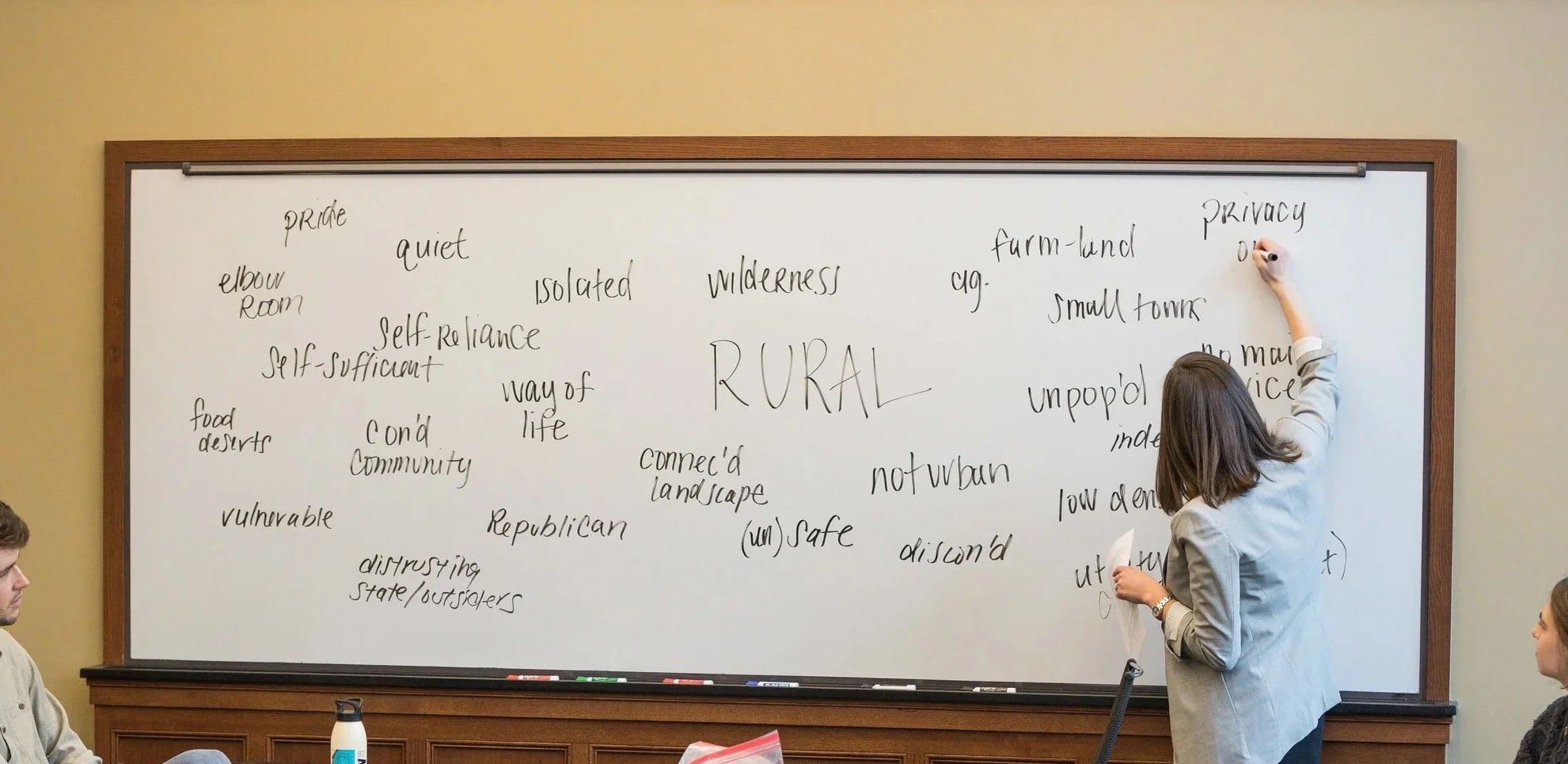
For many years I have taught a seminar called Law in Rural America. The course has changed over time, but it has always surveyed legal issues experienced by rural American communities and their residents. It was designed for students who were curious about the place of “the rural” in American law and politics. I encourage students to think seriously about how law shapes rural communities and how rural geography in turn shapes legal and policy implementation. In the process, we cover topics such as rural legal aid, American Indian law, farmworkers rights, land use, and rural legal practice.
Below I’ve gathered different teaching tools and showcased student work. I especially encourage you to check out the student-written JOTWELLs and their infographics.
The field of rural law is a growing subfield.
More law schools are offering courses on rural legal issues. But you don't have to think of yourself as a rural legal scholar to find this field applicable to your own teaching and research.
Below is an online version of my Law in Rural America seminar. The materials assembled below are not exhaustive, and I welcome your suggestions for additional materials.
Course Description: Law in Rural America
This course surveys some of the legal issues experienced by rural American communities and their residents. It is designed for those curious about the place of “the rural” in American law and politics. This course will push you to think seriously about how law shapes rural communities and how rural geography in turn shapes legal and policy implementation.
The course will survey a broad range of legal subfields and expose you to historical and contemporary legal problems specific to rural communities in the United States by using legal, political, and historical sources. We will cover topics such as rural legal aid, American Indian law, farmworkers rights, land use, and rural legal practice. In the process we’ll consider changing legal definitions of the rural, consider how each of the topics covered are intertwined, and rethink the place of rural communities in American law and policy.
Reading Lists
The Rural Reconciliation Project has created a database of rural law syllabi. I have included by 2024 and 2026 reading lists as part of that database here.
The Rural Reconciliation Project also has a database of rural law research guides, and reading lists.
Example Assignment: JOTWELLs
JOTWELL is the Journal of Things We Like (Lots), and it provides a platform for legal scholars to celebrate good scholarship. They publish 500-1000 word reviews of recently written articles and books. Your review should explain the value of the work being reviewed, explain the main argument(s), and get the reader excited to read the article. The focus should not be on critique or criticism, even though you should still take a critical eye to the work.
Read the author guidelines for “Writing the ‘Jot’” here: https://jotwell.com/style-guide/.
Published Student JOTWELLs:
Katherine Klein reviewed Maybell Romero’s Viewing Access to Justice for Rural Mainers of Color Through a Prosecution Lens
Jackson Erpenbach reviewed Ann Eisenberg’s Rural Blight
Aiden Park reviewed Hannah Haksgaard’s Rural Practice as Public Interest Work
Sam Shaw reviewed Jordan Gross’s Pretrial Justice in Out-of-the-Way Places – Including Rural Communities in the Bail Reform Conversation
Kyle Emili reviewed Jessica Shoemaker and James Fallows Tierney’s Trading Acres.
Example Assignment: Infographics
An infographic is a visual representation of information, quickly communicating key data to the reader. Like other academic scholarship, it communicates a central argument, contributes to our knowledge base, and is accurately cited. Students in my seminar create infographics and present their findings on the last day of class. The students’ goal is to produce something that is useful to others, be they academics, lawyers, rural residents, or other public audience.
I’ve written about this assignment for the Rural Reconciliation Project, here. There I link to the infographics of five students, Robert Brewer, Mitchell Forbes, Taylor Hopkins, Ian Klopfenstein, and Ryan Sharpstene.
I’ve also assembled a collection of 16 usable infographics in the gallery linked here.